

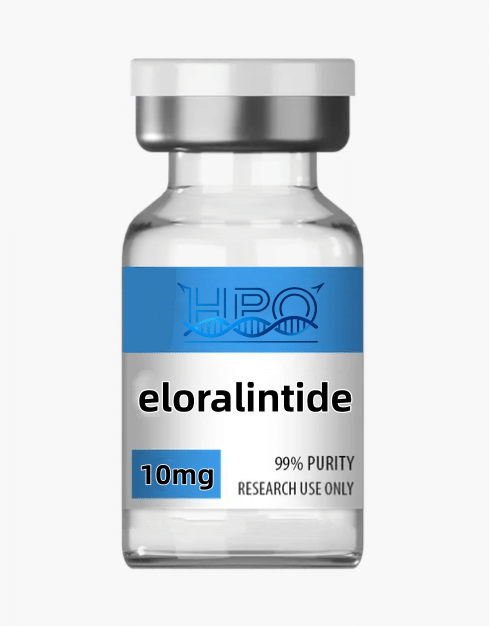
Eloralintide
$300.00
Eloralintide (LY3841136) 10 mg research vial — a selective amylin 1 receptor (AMY1R) agonist supplied as lyophilised powder. Lot-level COA with HPLC and MS documentation. For laboratory research only; not for human or veterinary use.
DISCLAIMER:
Eloralintide 10mg Research Guide: Selective Amylin Receptor Agonism
Eloralintide (development code LY3841136) is an investigational synthetic analogue of amylin, engineered as a selective agonist of the amylin 1 receptor (AMY1R). It belongs to the small but growing group of incretin-adjacent peptides that act on satiety signalling rather than on GLP-1 or GIP receptors. This 10 mg vial is supplied as lyophilised powder for laboratory research only.
The compound is not approved for any clinical indication. All information below describes published pharmacology and development status for research context; it is not a protocol and does not describe administration to humans or animals.
What eloralintide is
Eloralintide is an amylin analogue conjugated to a C20 fatty diacid, a modification that allows reversible binding to albumin and extends plasma residence time. Published characterisation reports that it activates the human AMY1R with roughly twelve-fold greater potency than the human calcitonin receptor, and that it was engineered for low immunogenicity risk and reduced tendency to self-aggregate into fibrils compared with native human amylin.
| Attribute | Detail |
|---|---|
| Research name | Eloralintide (LY3841136) |
| Class | Amylin analogue; selective AMY1R agonist |
| Vial content | 10 mg lyophilised powder |
| Developer | Eli Lilly and Company |
| Development stage | Phase 3 ongoing (obesity and related conditions); not approved |
| Identity and purity | Documented per lot on the certificate of analysis |
| Intended use | Laboratory research only |
Receptor pharmacology
Amylin receptors are heteromeric complexes formed by the calcitonin receptor core and one of three receptor activity-modifying proteins (RAMP1, RAMP2 or RAMP3). The RAMP composition determines whether the complex behaves as an amylin-preferring (AMY1R) or calcitonin-preferring receptor, which is why selectivity is a meaningful design parameter rather than a marketing detail. AMY1R activation engages Gs-coupled cyclic AMP signalling and downstream satiety circuitry, including actions within the brainstem and hypothalamic regions that regulate meal termination.
For laboratory work, the practical consequence is that eloralintide should not be treated as interchangeable with GLP-1, GIP or triple-agonist peptides. Receptor panels, cAMP assays and selectivity counterscreens need to be designed around AMY1R biology, and results obtained with one receptor class do not transfer to another.
Engineering: albumin binding and residence time
The C20 fatty diacid conjugation is the reason eloralintide behaves as a long-acting peptide. Albumin binding creates a depot-like circulating reservoir, slowing clearance without requiring repeated high exposure. Native amylin, by contrast, is short-lived and prone to aggregation; the analogue was designed to avoid both liabilities. In the laboratory, this matters for stability work: aggregation and adsorption behaviour should be monitored with the same methods used for other lipophilic, albumin-binding peptides.
Clinical development status
Eloralintide has completed Phase 1 and Phase 2 studies in adults with obesity or overweight, and Phase 3 trials are ongoing in obesity and related conditions including obstructive sleep apnea and knee osteoarthritis pain. A separate programme, EloraTZP, combines eloralintide with tirzepatide as a co-formulation; its 48-week Phase 2b study has completed, with Phase 3 planned to start in the fourth quarter of 2026.
None of this constitutes approval or a therapeutic recommendation. Research-grade material supplied here is a reference standard for bench work, not a finished pharmaceutical product.
For context on the wider amylin analog class, including how selectivity and albumin binding shape research design, see our cagrilintide amylin analog research guide.
Research-use considerations
Three practical points recur when this class of peptide is used in vitro or in early formulation work:
- Lot continuity. Receptor-potency comparisons are sensitive to batch-to-batch variation. Keep the same lot across a study arm and record the lot number in every data sheet.
- Adsorption and aggregation. Lipophilic, albumin-binding peptides readily adsorb to plastic and can self-assemble at interfaces. Low-binding tubes and consistent buffer composition reduce artefacts.
- Assay controls. Include vehicle controls and, where possible, a reference amylin agonist in the same plate. AMY1R responses are modest in absolute terms and benefit from a same-run comparator.
COA and lot verification
Every vial ships with a lot-level certificate of analysis. Before starting work, confirm that the lot number on the COA matches the label on the vial, that the HPLC method is stated with column, mobile phase and gradient, and that the chromatogram includes integrated peak areas rather than a bare percentage. Identity should be supported by mass spectrometry with an observed mass consistent with the expected construct.
Our field-by-field guide to reading these documents is here: peptide certificate of analysis fields and verification guide. For comparison with incretin-based mechanisms, see the triple receptor agonist review.
Frequently asked questions
Is eloralintide approved for clinical use?
No. It remains an investigational compound; Phase 3 trials are ongoing.
Is eloralintide the same class as tirzepatide or retatrutide?
No. Tirzepatide is a GIP/GLP-1 dual agonist and retatrutide is a GIP/GLP-1/glucagon triple agonist; eloralintide is a selective amylin receptor agonist. The receptor biology, assay design and selectivity profiles differ.
How should the lyophilised powder be handled?
Keep the sealed vial at -20 °C, protected from light, and equilibrate to room temperature before opening to avoid condensation. Reconstitution and buffer choice follow your own laboratory protocol; this page does not provide administration guidance.
What documentation is provided?
A lot-level COA covering identity, purity and analytical method, plus batch records on request. This material is sold for laboratory research only and is not for human or veterinary use.
Only logged in customers who have purchased this product may leave a review.
Related products
Reviews
There are no reviews yet.