

KLOW Peptide Blend: Four-Component Identity and Laboratory Quality Guide
FOR RESEARCH USE ONLY. KLOW peptide blend is supplied solely as an analytical and in vitro laboratory reagent. Not for human or veterinary use, food, cosmetic, household, diagnostic, or therapeutic purposes.
Overview
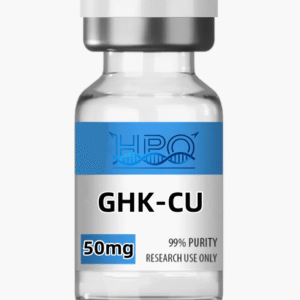
KLOW peptide blend is the catalog name for a four-component research mixture declared as BPC-157 10 mg, GHK-Cu 50 mg, TB-500 10 mg, and KPV 10 mg. Those numbers are nominal component amounts attached to the catalog configuration; they are not a substitute for the batch certificate of analysis (CoA), net peptide-content testing, copper measurement, counterion determination, or stability data. Because the mixture combines chemically different analytes, the identity and quantity of every component must be established independently. A single chromatographic purity percentage or total vial mass cannot confirm the four identities or their individual amounts.
The blend name is commercial shorthand, not an established pharmacological entity. Published studies normally examine BPC-157, GHK or GHK-Cu, TB-500, thymosin beta-4, or KPV separately. Evidence for one component cannot be reassigned to the complete mixture, and four separate preclinical observations do not demonstrate an additive or synergistic blend effect. This page therefore focuses on chemical identity, analytical controls, experimental design, and evidence boundaries. It intentionally provides no administration, dosage, preparation, or combination-use instructions.
The four materials also differ in size, charge, metal coordination, ultraviolet response, ionization behavior, and possible salt forms. BPC-157 is a 15-residue peptide; GHK-Cu is a copper complex of a tripeptide; FDA describes TB-500 as an N-terminally acetylated seven-residue fragment of thymosin beta-4; and KPV is a three-residue peptide. These differences make a blend analytically more demanding than a single purified peptide. Researchers should use the exact declared form and lot documentation rather than treating the component names as complete specifications.
Declared composition and identity boundaries
| Component | Catalog amount | Sequence or complex | Reference identity | Important boundary |
|---|---|---|---|---|
| BPC-157 | 10 mg | H-Gly-Glu-Pro-Pro-Pro-Gly-Lys-Pro-Ala-Asp-Asp-Ala-Gly-Leu-Val-OH GEPPPGKPADDAGLV |
Free peptide: C62H98N16O22; average mass 1419.5 g/mol; CAS 137525-51-0; PubChem CID 9941957; UNII 8ED8NXK95P.[1][2] | Free peptide and acetate are distinct forms. Counterion, water, and peptide content affect mass balance. |
| GHK-Cu | 50 mg | Copper complex of Gly-His-Lys; commonly represented as a 1:1 Cu(II)-GHK complex | PubChem CID 71587328; CAS 89030-95-5; the PubChem complex record gives C14H23CuN6O4+ and average mass 402.92 g/mol.[5] | GHK, GHK-Cu, and counterion-containing GHK-Cu materials are not mass-equivalent. Copper stoichiometry must be measured. |
| TB-500 | 10 mg | Ac-Leu-Lys-Lys-Thr-Glu-Thr-Gln-OH Ac-LKKTETQ |
Free peptide: C38H68N10O14; average mass 889.01 g/mol; CAS 885340-08-9; PubChem CID 62707662; UNII QHK6Z47GTG.[9][10] | TB-500 is not full-length 43-residue thymosin beta-4. The N-terminal acetyl group is part of its identity. |
| KPV | 10 mg | H-Lys-Pro-Val-OH KPV |
Free peptide: C16H30N4O4; average mass 342.43 g/mol; CAS 67727-97-3; PubChem CID 125672.[13][15] | Free peptide and acetate are different gross compositions even though the KPV active moiety is shared. |
The table reports reference identities, not batch results. FDA’s 2026 briefing materials distinguish free peptide and acetate forms for BPC-157, TB-500, and KPV and document recurring naming and CoA inconsistencies.[2][9][15] A lot labeled only with a short common name cannot be assumed to match the free-peptide formula. The current CoA must define the form represented by each reported amount.
What a four-component blend does and does not establish
A blend creates a new analytical matrix. It does not create a new evidence base automatically. Chemical co-presence may change recovery, chromatographic selectivity, metal speciation, adsorption, degradation, or assay interference. Those possibilities require direct testing. They are not proof of biological cooperation. Claims such as “complementary pathways,” “repair network,” or a greater-than-additive response require a prespecified factorial experiment that compares every component alone, relevant partial combinations, the complete blend, and an appropriate mixture model.
The declared amounts total 80 mg arithmetically, but gross material mass is not necessarily 80 mg of active moieties. Counterions, copper, water, residual solvent, and other non-peptide mass can contribute. Conversely, a nominal component amount may refer to the salt, the peptide moiety, or another basis unless the specification defines it. Quantitative conclusions should state the measurement basis for each analyte. For GHK-Cu, the laboratory should distinguish GHK-equivalent, complex-equivalent, and elemental-copper results. For acetate-containing peptides, report whether amount is calculated as free peptide, salt, or as-is material.
A mixture also complicates purity language. HPLC area percentage at one wavelength is not equivalent to mass fraction, sequence confirmation, copper stoichiometry, sterility, endotoxin status, or component potency. Different analytes can have different detector responses, and some impurities may lack comparable ultraviolet response. No universal purity or stability value follows from the product name. Only lot-specific results generated with stated methods should be used.
Component evidence map
BPC-157: sequence-defined pentadecapeptide
BPC-157 is represented in PubChem and FDA identity records as the 15-residue sequence GEPPPGKPADDAGLV.[1][4] The literature includes cell and animal models involving gastrointestinal, vascular, musculoskeletal, and other endpoints. A 2025 systematic review of orthopaedic research found that nearly all included studies were preclinical and that the single small human report was retrospective and uncontrolled.[3] Such evidence can motivate laboratory hypotheses but cannot establish clinical effectiveness, safety, or a validated use for this blend.
FDA’s 2026 review of BPC-157-related bulk drug substances highlighted limited human information, characterization challenges, peptide-related impurities, aggregation, and potential immunogenicity concerns for certain proposed routes. FDA also distinguished BPC-157 free peptide from BPC-157 acetate and noted that a bulk identity record does not establish approval.[2] Researchers should avoid transferring a literature result to a lot unless sequence, salt form, content, and integrity are documented. The component’s presence in a mixture adds matrix variables that the single-component studies did not test.
GHK-Cu: peptide-metal coordination complex
GHK is glycyl-L-histidyl-L-lysine. GHK-Cu denotes a copper-coordinated form rather than a longer peptide. The histidine imidazole, peptide nitrogens, and terminal groups contribute to coordination behavior that depends on pH, competing ligands, ionic strength, and the declared material form. PubChem’s standardized prezatide copper record provides a useful reference identity, but a commercial lot may include counterions, water, uncomplexed GHK, free copper, or other copper species that require separate assessment.[5]
Historical studies reported extracellular-matrix-related endpoints in fibroblast cultures and a rat wound-chamber model.[6][7] Those model-specific findings do not demonstrate that a KLOW mixture has the same response. They also do not establish the contribution of the 50 mg declared component when copper occupancy, intact complex concentration, and matrix stability are unknown. A blend study should monitor copper-dependent optical or redox interference and include GHK without copper, a copper-matched control, and the intact GHK-Cu complex when the scientific question requires mechanistic separation.
FDA currently lists GHK-Cu other than injectable use as a bulk substance under evaluation for the section 503A process, while its safety-risk materials identify concerns for injectable routes. Category status is not approval, and it is subject to change.[8] This catalog entry is a research-use listing and should not be interpreted as a compounded-drug or cosmetic-use authorization.
TB-500: an acetylated heptapeptide, not thymosin beta-4
TB-500 naming is often confused with thymosin beta-4. FDA’s 2026 scientific review defines TB-500 as the N-terminally acetylated heptapeptide Ac-LKKTETQ, corresponding to residues 17 through 23 of the 43-residue thymosin beta-4 sequence.[9] Analytical reports also identified N-acetylated LKKTETQ in products sold as TB-500.[11] Full-length thymosin beta-4 and TB-500 differ greatly in sequence, molecular mass, folding possibilities, impurity profile, and biological context. Their names must not be used interchangeably.
A 2024 mass-spectrometry study examined TB-500 and metabolites in vitro and in rats and reported that certain assay signals could differ between the parent and its metabolites.[12] This reinforces the need to measure intact material during the experimental interval rather than assuming nominal exposure. FDA’s review also describes free peptide and acetate as distinct bulk drug substances and notes sensitivity to formulation, process, and environmental conditions.[9] These findings support stability-indicating analysis, not a therapeutic or tissue-repair claim.
KPV: Lys-Pro-Val tripeptide
KPV is the sequence H-Lys-Pro-Val-OH and corresponds to the 11–13 segment of alpha-melanocyte-stimulating hormone in common nomenclature. PubChem lists the free peptide as C16H30N4O4 with an average molecular mass of 342.43 g/mol.[13] Cell and mouse studies have investigated PepT1-dependent uptake and inflammatory signaling endpoints.[14] These studies are useful for designing transporter and pathway assays but do not demonstrate a human outcome or a KLOW blend effect.
FDA’s 2026 review reported no identified published human studies using KPV free peptide or acetate and distinguished the two forms by gross composition.[15] The same review evaluated proposed compounding uses; that regulatory process does not validate a commercial blend. KPV’s small size may produce early chromatographic elution, strong matrix dependence, and ionization competition in a mixture. A method should establish recovery and specificity for KPV in the presence of the other three components.
Designing interpretable blend experiments
- Define the material. Record lot number, declared component amounts, each chemical form, peptide-content basis, copper basis, water, counterions, storage history, and opening date. Do not infer these attributes from the product title.
- Separate identity from activity. Confirm all four analytes before using the material in a biological assay. A response cannot rescue an unverified chemical identity.
- Use a component matrix. Include each component alone, vehicle, relevant counterion and copper controls, and the complete blend. Partial combinations may be required to identify interactions.
- Prespecify the interaction model. Additivity, antagonism, and synergy depend on a quantitative reference model and a response surface. A larger response from the blend than from one component is not sufficient evidence of synergy.
- Match exposure on a defined basis. Decide whether comparisons use mass, molarity, active-moiety equivalents, or another justified basis. The four components have very different molecular masses.
- Measure intact analytes over time. Determine recovery at the beginning and end of the assay. Proteolysis, adsorption, copper exchange, oxidation, pH, serum components, and vessel material can change actual exposure.
- Control optical and redox interference. Run material-plus-reagent wells without cells for fluorescence, absorbance, luminescence, ROS probes, and colorimetric assays. GHK-Cu can introduce color and metal-dependent chemistry.
- Use orthogonal endpoints. Confirm a central result with a chemically independent method. Cell number, viability, migration, matrix deposition, cytokine abundance, and reporter activity should be measured separately.
- Protect reproducibility. Randomize positions, blind imaging and integration, report all exclusions, use independent biological replicates, track reagent lots, and control multiplicity.
A four-component experiment has more degrees of freedom than a single-agent experiment. Testing many concentrations, times, and outcomes can produce chance findings unless the primary hypothesis and analysis plan are defined in advance. Where the purpose is analytical rather than biological, use a qualified reference material for each component and evaluate matrix effects across the working range. Where the purpose is mechanistic, perturb the proposed pathway and demonstrate temporal ordering rather than relying only on correlated biomarkers.
Analytical quality control for KLOW peptide blend
A fit-for-purpose quality package should make four separate identity statements and four separate quantitative statements. The following tests are examples of analytical questions, not guarantees about a particular lot:
- Component identity: use LC–HRMS with mass tolerance, isotope pattern, charge-state and adduct assignments. Confirm BPC-157 and TB-500 sequence by justified MS/MS or comparison with qualified references. Confirm the TB-500 N-terminal acetyl group.
- GHK-Cu identity: combine peptide identity with elemental copper and a method capable of supporting the declared complex or stoichiometry. Intact-mass behavior alone may be affected by source conditions and ligand exchange.
- Component quantitation: use calibrated, component-specific methods. Detector response factors should be established rather than assuming equal HPLC area per unit mass.
- Net peptide content: distinguish chromatographic area purity from actual content. Quantitative amino-acid analysis, validated reference-standard assays, or suitable quantitative NMR may contribute, subject to mixture limitations.
- Related substances: assess deletion sequences, truncations, oxidized or hydrolyzed products, epimers, deamidation where relevant, TB-500 deacetylation, and KPV or BPC-157 sequence-related impurities.
- Counterions, water, and residues: determine acetate or other counterions, water, residual solvents, and elemental impurities according to synthesis and purification knowledge. Report whether component amounts are on an as-is or corrected basis.
- Aggregation and particles: use orthogonal methods when relevant. A clear appearance or a single SEC result does not exclude every aggregate or subvisible particle.
- Matrix recovery: demonstrate that all four analytes can be recovered from the intended research matrix and container. Evaluate carryover and ion suppression explicitly.
- Biological-assay compatibility: assess endotoxin, bioburden, or mycoplasma only where the in vitro design requires them. Such results do not establish suitability for use in people or animals.
Method validation should address specificity, accuracy, precision, range, robustness, and system suitability for the actual mixture. ICH Q2(R2) provides an official framework for analytical procedure validation.[17] Using that framework voluntarily does not convert a research reagent into an approved medicine. Raw chromatograms, spectra, integration rules, calibration traceability, and acceptance criteria are more informative than an unsupported “high purity” label.
Lot-specific handling and stability
The lot label, CoA, and current safety data sheet control storage and handling. Keep the container sealed under the supplier’s stated condition, minimize moisture and uncontrolled light exposure, and document temperature excursions. Handle the dry material as a research chemical with incompletely characterized occupational hazards, using trained personnel, task-appropriate protective equipment, controlled weighing practices, and institutional risk assessment.
This page intentionally provides no solution-preparation procedure. Any analytical solution should be governed by a laboratory-approved, matrix-specific SOP. Record the material form, solvent or buffer, pH, container, concentration basis, copper status, and elapsed analytical interval. Establish stability in the exact matrix using a method that can distinguish all four intact components and relevant degradation products. Do not assign a generic usable interval, freeze–thaw tolerance, or shelf life without lot- and method-specific evidence.
Mixture stability is not necessarily the minimum of four single-component values. Components may interact with surfaces, trace metals, buffers, preservatives, or one another. GHK-Cu can exchange copper with competing ligands; larger peptides can adsorb or aggregate; and small peptides can be obscured by solvent-front or matrix signals. These are experimental variables to measure. Dispose of material and contaminated consumables through institutional chemical-waste procedures.
Evidence and regulatory boundary
KLOW is not the subject of an established clinical literature. The component evidence is largely preclinical and heterogeneous, and no cited study validates the declared four-component mixture. Results from fibroblast cultures, endothelial cells, intestinal cell lines, rodents, horses, or other models remain specific to those systems. They do not establish effectiveness, safety, pharmacokinetics, or a health outcome in people.
FDA’s 2026 PCAC materials reviewed BPC-157-, KPV-, and TB-500-related bulk drug substances separately, not as KLOW.[16] FDA substance identifiers and PubChem records describe chemical identity; they do not imply approval. FDA also notes characterization, impurity, aggregation, and evidence gaps for several of these substances. GHK-Cu has a separate and evolving section 503A evaluation status for certain proposed contexts.[8] None of these regulatory records authorizes a health claim for this research mixture.
No conclusion about tissue repair, inflammation, collagen, wounds, joints, muscle, intestine, skin, cancer, immunity, or recovery follows from the catalog composition. A research-use disclaimer cannot correct contradictory dosing or therapeutic content; those claims and instructions are deliberately excluded. Qualified researchers are responsible for lawful procurement, institutional review, test-article verification, experimental design, occupational safety, and waste disposal.
Frequently asked questions
1. What is KLOW peptide blend?
It is a cataloged four-component research mixture declared as BPC-157 10 mg, GHK-Cu 50 mg, TB-500 10 mg, and KPV 10 mg. The name does not define salt forms, copper basis, water, counterions, purity, or actual batch content; those attributes must come from the lot documentation and analytical data.
2. Does the blend have one molecular formula or molecular weight?
No. It is a mixture of chemically distinct components, not a single covalent molecule. Each component has its own identity and possible salt or hydration state. A single formula or molecular mass for KLOW would be misleading.
3. Is TB-500 the same as thymosin beta-4?
No. FDA describes TB-500 as N-acetylated LKKTETQ, a seven-residue segment corresponding to residues 17–23 of full-length 43-residue thymosin beta-4. The two materials must be distinguished in literature review and analytical work.
4. Does GHK-Cu mean GHK plus an unspecified amount of copper?
GHK-Cu normally denotes a defined copper-coordinated GHK complex, but the actual stoichiometry, counterion, water, uncomplexed peptide, and free copper are lot-specific analytical questions. The CoA should state the reporting basis for the 50 mg declaration.
5. Can four separate component studies prove that the blend is synergistic?
No. Synergy is a quantitative interaction claim. It requires direct comparison of components, partial combinations, the complete mixture, and a prespecified reference model. Separate papers do not provide that evidence.
6. Is an HPLC purity result enough to release the blend?
No. One HPLC area result cannot by itself establish four identities, four quantities, copper stoichiometry, sequence, stereochemistry, water, counterions, residual solvents, aggregation, or assay compatibility. Orthogonal and component-specific methods are needed.
7. Why must free peptide and acetate forms be distinguished?
Counterions contribute mass and can change charge, recovery, chromatography, and amount calculations. FDA’s 2026 reviews document form and CoA inconsistencies for several named components. The measurement basis must be explicit.
8. What documentation should accompany a KLOW research lot?
Review the lot number, four declared identities, sequence or complex data, individual quantitative results, material forms, copper result, chromatographic methods, water, counterions, storage condition, retest status, and relevant raw data. Additional tests depend on the intended in vitro or analytical system.
Related research navigation
- GHK-Cu and KPV — navigation to the individual research materials.
- TB-500 — navigation to the separately listed TB-500 research material; verify the declared form on its current lot documents.
- GHK-Cu + KPV blend — navigation to a different two-component mixture. No combined-use or shared-effect claim is implied.
- Terms of Service — site terms and research-use conditions.
References
- National Center for Biotechnology Information. PubChem Compound Summary: BPC-157, CID 9941957. Sequence, formula, mass, and identifiers.
- U.S. Food and Drug Administration. FDA briefing document for BPC-157-related bulk drug substances. Pharmacy Compounding Advisory Committee, 2026.
- Vasireddi N, Hahamyan H, Salata MJ, et al. Emerging Use of BPC-157 in Orthopaedic Sports Medicine: A Systematic Review. HSS Journal. 2025. PMID 40756949.
- U.S. Food and Drug Administration. GSRS identity record: BPC-157, UNII 8ED8NXK95P. A UNII does not imply approval.
- National Center for Biotechnology Information. PubChem Compound Summary: Prezatide copper, CID 71587328.
- Maquart FX, Bellon G, Chaqour B, et al. In vivo stimulation of connective tissue accumulation by the tripeptide-copper complex GHK-Cu2+ in rat experimental wounds. Journal of Clinical Investigation. 1993. PMID 8227353.
- Maquart FX, Pickart L, Laurent M, et al. Stimulation of collagen synthesis in fibroblast cultures by the tripeptide-copper complex GHK-Cu. FEBS Letters. 1988. PMID 3169264.
- U.S. Food and Drug Administration. Bulk Drug Substances Nominated for Use in Compounding Under Section 503A. Current category information and status limitations.
- U.S. Food and Drug Administration. FDA briefing document for TB-500-related bulk drug substances. Identity, form, characterization, and evidence review, 2026.
- National Center for Biotechnology Information. PubChem Compound Summary: TB-500, CID 62707662.
- Ho ENM, Kwok WH, Lau MY, et al. Synthesis and characterization of the N-terminal acetylated 17–23 fragment of thymosin beta-4 identified in TB-500. Drug Testing and Analysis. 2012. PMID 22962027.
- Rahaman KA, et al. Simultaneous quantification of TB-500 and its metabolites in in-vitro experiments and rats by UHPLC–MS/MS. Journal of Chromatography B. 2024. PMID 38382158.
- National Center for Biotechnology Information. PubChem Compound Summary: Lys-Pro-Val, CID 125672.
- Dalmasso G, Charrier-Hisamuddin L, Nguyen HTT, et al. PepT1-mediated tripeptide KPV uptake reduces intestinal inflammation. Gastroenterology. 2008. PMID 18061177.
- U.S. Food and Drug Administration. FDA briefing document for KPV-related bulk drug substances. Identity, form, characterization, and evidence review, 2026.
- U.S. Food and Drug Administration. July 23–24, 2026 Pharmacy Compounding Advisory Committee meeting. Agenda and review materials.
- U.S. Food and Drug Administration. Q2(R2) Validation of Analytical Procedures. Final guidance, March 2024.
Final research-use disclaimer
FOR RESEARCH USE ONLY. KLOW peptide blend is a laboratory reagent, not a drug, medicine, supplement, food, cosmetic, diagnostic, or medical device. It is not for human or veterinary use and is not intended to diagnose, prevent, mitigate, cure, or treat any condition. Component studies are model-specific and do not establish the safety, effectiveness, pharmacokinetics, interaction, or quality of this four-component lot. Qualified researchers are responsible for lawful procurement, institutional review, risk assessment, test-article verification, experimental design, handling, and disposal.
Reviews
There are no reviews yet.